
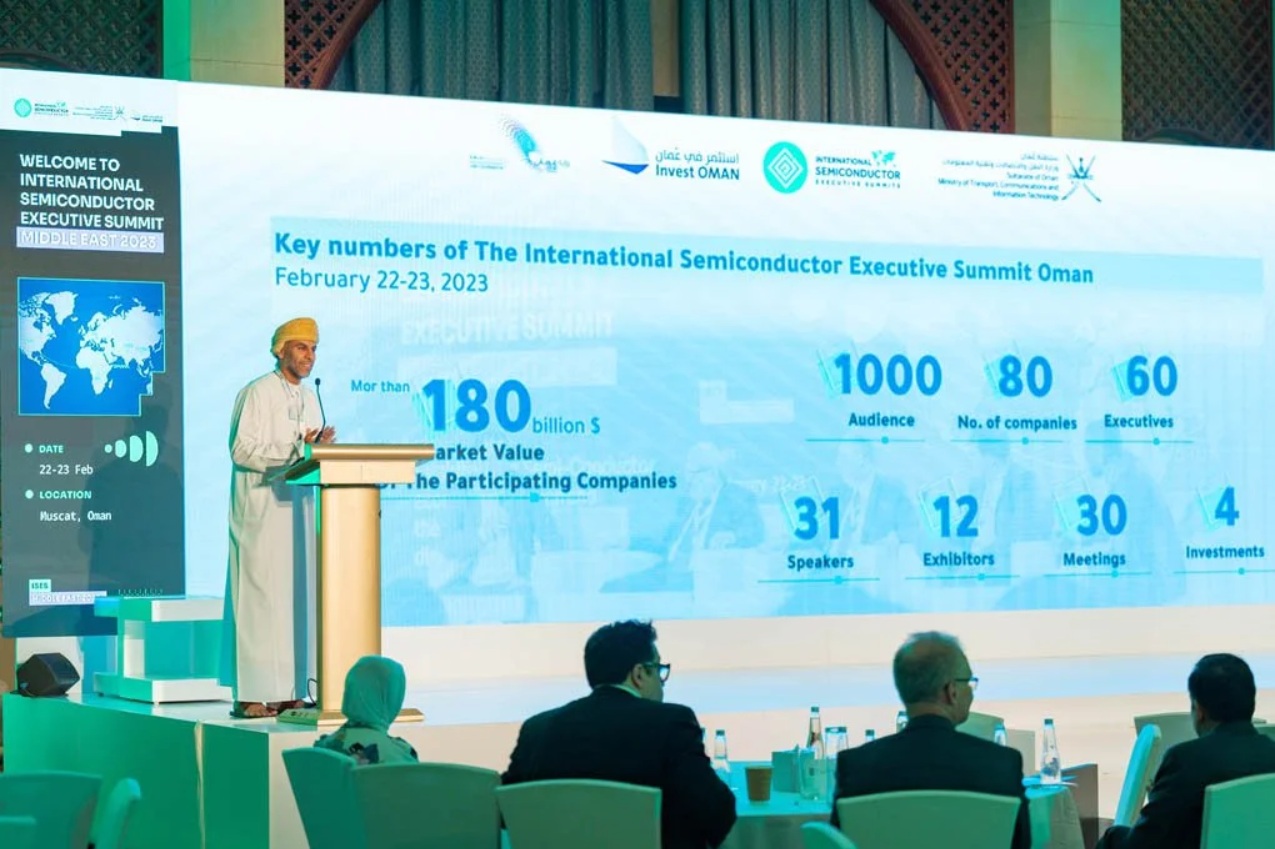
Oman is moving with deliberate speed to position itself as a new strategic hub for the global semiconductor and artificial intelligence industries. The country sits at a geographic crossroads between East and West, giving it direct access to Asian fabrication giants and Western technology markets. At the same time, Oman is undergoing a national digital transformation program that aims to modernize its economy, build advanced technological capability, and attract international expertise. This creates a powerful foundation for global companies seeking a stable, well-supported entry into the Middle East’s semiconductor market, which today lacks regional IC design clusters, OSAT facilities, and advanced packaging capabilities.
The global context reinforces why Oman is stepping into this space. Worldwide demand for semiconductors is expanding rapidly, with IC design generating over thirteen billion dollars in annual revenue and the OSAT market projected to reach more than forty-four billion dollars within the next few years. Advanced packaging is shifting from traditional 2D structures to 2.5D and 3D architectures, driven by AI, machine learning, electric vehicles, cloud computing, and high-performance electronics. While global demand accelerates, the Middle East remains almost entirely underserved. This gap presents Oman with a once-in-a-generation opportunity to create the region’s first integrated semiconductor and AI ecosystem.
Oman plans to execute this strategy through a combination of talent development, investor incentives, and infrastructure readiness. The country seeks to attract investors capable of establishing integrated circuit design companies focused on networking, communications, automotive systems, consumer electronics, and government technology. These design houses can operate on a fabless model, outsourcing fabrication to global foundries while developing high-value intellectual property within Oman. Alongside this, Oman intends to host the Middle East’s first outsourced semiconductor assembly and testing facility, providing IC packaging, chip testing services, and advanced packaging capabilities. With free land, economic zones, and a highly connected digital backbone, Oman offers companies the ability to establish design and OSAT operations with reduced cost and accelerated timelines.
Complementing these developments is a growing focus on talent. Oman recognizes the global shortage of semiconductor design engineers and is actively transforming this challenge into an investment opportunity by supporting training, skills development, and partnerships with technology leaders. With nearly full nationwide digital connectivity and a government committed to building a full semiconductor ecosystem, companies entering Oman can expect strong institutional collaboration.
Artificial intelligence acts as the multiplier that ties this strategy together. AI is expected to become a billion-dollar opportunity in Oman by 2030 across manufacturing automation, chip verification, predictive maintenance, EDA optimization, lab testing intelligence, and national digital infrastructure. As semiconductor designs become more complex and packaging technologies evolve, AI-driven workflows will become a necessity rather than an option. Oman intends to embed AI at the center of semiconductor design and manufacturing to increase efficiency, reliability, and competitiveness.
Engine AI plays an essential role in enabling international partnerships throughout this transformation. As a national integrator and technology partner, Engine AI supports foreign companies by localizing systems, adapting semiconductor and AI tools to Omani requirements, connecting partners with government entities, securing compliance pathways, and managing on-the-ground deployment. Global semiconductor companies, OSAT operators, AI developers, and technology investors can rely on Engine AI as their dedicated gateway to enter Oman, reduce operational complexity, and establish long-term presence in the region.
The investment opportunities themselves are substantial. An IC design company in Oman requires an estimated investment of around thirty million dollars and can employ between thirty and one hundred engineers, with a setup period of one to two years. The OSAT opportunity is significantly larger, requiring an investment between one hundred thirty and one hundred forty million dollars, employing more than three hundred specialists, and benefiting from free industrial land with a two- to three-year setup window. Both opportunities are designed to serve not only the Omani market but also regional and global semiconductor supply chains.
Engine AI invites international semiconductor companies, design specialists, OSAT operators, fabless innovators, advanced packaging experts, and AI-driven manufacturing technology leaders to participate in building Oman’s next-generation semiconductor and AI industry. Companies that join early will gain a first-mover advantage in a region with enormous untapped demand and fully aligned national support.
For partnership discussions, investment collaboration, or joint venture exploration, interested organizations can contact Engine AI at executiveoffice@engineai.om.