
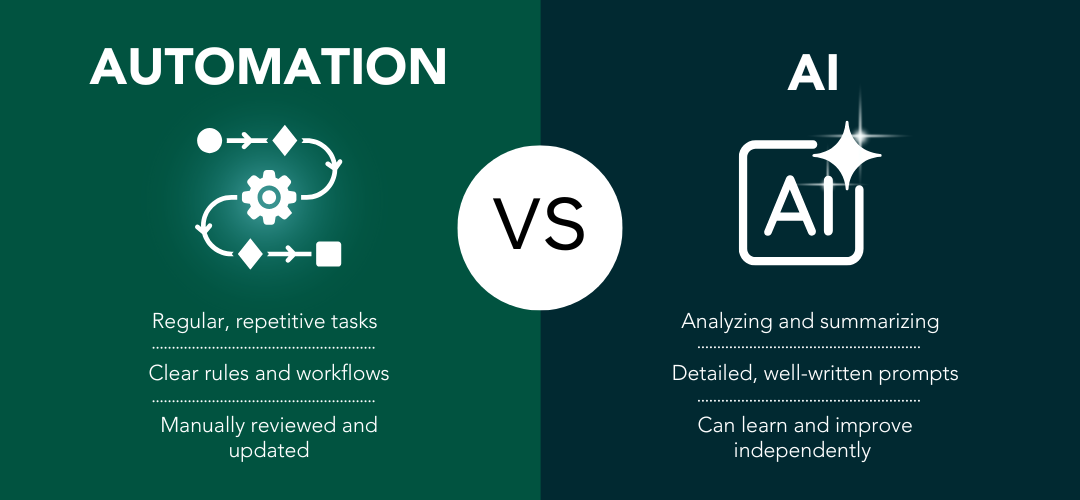
Across industries, the momentum behind AI is undeniable. Leadership teams are increasingly prioritizing AI initiatives as a pathway to efficiency, innovation, and competitive differentiation. However, a critical issue is emerging. Many organizations are pursuing AI before establishing the operational foundations required to support it. This approach does not accelerate transformation. Instead, it introduces risk, increases cost, and delays value realization. The organizations delivering measurable results are taking a different path by prioritizing automation first and then applying AI with precision.
AI is often positioned as a standalone solution, but in reality, its effectiveness is directly dependent on the quality of the underlying processes. When deployed on top of fragmented or manual operations, AI initiatives tend to produce inconsistent outputs, limited trust from stakeholders, and significant challenges in scaling beyond pilot phases. In many cases, the return on investment remains unclear or undefined. In this context, AI becomes an overlay on inefficiency rather than a true driver of performance.
Automation, by contrast, serves as the operational foundation. It is not a competing priority to AI, but a prerequisite for it. Well-structured automation ensures process reliability, consistent execution, and the elimination of manual inefficiencies while delivering clear and quantifiable cost savings. More importantly, it establishes standardized workflows, clean and structured data, and measurable performance baselines. These are the essential conditions required for AI systems to function effectively and at scale.
Organizations that are realizing tangible benefits from digital transformation are not choosing between automation and AI. They are sequencing them deliberately. The first phase focuses on automation, where processes are standardized, workflows are digitized, manual intervention is reduced, and performance metrics are clearly defined. At this stage, organizations already achieve meaningful gains in efficiency, cost reduction, and operational reliability.
Once this foundation is in place, AI can be introduced to enhance and optimize performance. In this second phase, AI improves decision quality, identifies optimization opportunities, manages operational complexity, and continuously refines system performance. Rather than compensating for broken processes, AI amplifies systems that are already stable and effective, transforming it from an experimental tool into a force multiplier.
At Engine AI, this philosophy is applied through a structured and execution-focused approach designed specifically for asset-intensive industries. The process begins with stabilizing and standardizing operations by identifying inefficiencies, mapping processes, digitizing workflows, and integrating fragmented systems into a unified data environment. This creates a controlled and predictable operating foundation.
Following this, targeted automation is deployed to eliminate inefficiencies and generate immediate, measurable value. Repetitive operational and reporting tasks are automated, manual interventions are reduced, and performance monitoring mechanisms are embedded into workflows. This stage delivers tangible outcomes in the form of reduced operational costs, improved cycle times, and increased reliability across operations.
With a stable operational backbone in place, AI capabilities are then introduced where they can deliver real impact. This includes predictive analytics for maintenance, intelligent decision-support systems, and optimization models for resource allocation and throughput. AI is applied selectively, focusing only on areas where it enhances outcomes rather than adding unnecessary complexity.
This approach has been demonstrated in practice. In one case, a regional industrial operator managing multiple distributed assets faced inefficiencies in maintenance planning and operational reporting. The organization relied heavily on manual data consolidation, had inconsistent maintenance scheduling, and lacked visibility into asset performance. While the initial objective was to implement AI-driven predictive maintenance, the focus was first shifted toward building a solid operational foundation.
Through automation, data from multiple systems was integrated into a unified platform, reporting processes were automated, maintenance workflows were standardized, and real-time performance dashboards were introduced. This resulted in a 35 percent reduction in manual reporting effort, a 20 percent improvement in maintenance planning efficiency, and full visibility across operations. Only after this foundation was established were AI capabilities introduced, including predictive maintenance models and optimization tools. This led to a further 15 to 20 percent reduction in unplanned downtime and improved asset utilization across the network.
For organizations evaluating AI adoption, the priority should not be speed, but sequencing. A disciplined approach begins with assessing operational maturity, identifying gaps in process standardization and data quality, and prioritizing automation initiatives that deliver clear return on investment. Performance baselines must be established to ensure improvements are measurable, and AI should be introduced selectively where it enhances already stable systems.
AI is a powerful enabler, but it does not replace the need for operational discipline. Organizations that succeed are those that build reliable systems first, apply intelligence second, and focus on measurable outcomes at every stage. At Engine AI, AI is not positioned as the starting point, but as the layer that unlocks the next level of performance once the foundation is secure.
The strategic question for leadership is clear. Is your organization building the operational foundation required for AI to succeed, or investing in capabilities that depend on it without first securing it?